
Last updated October 15, 2026
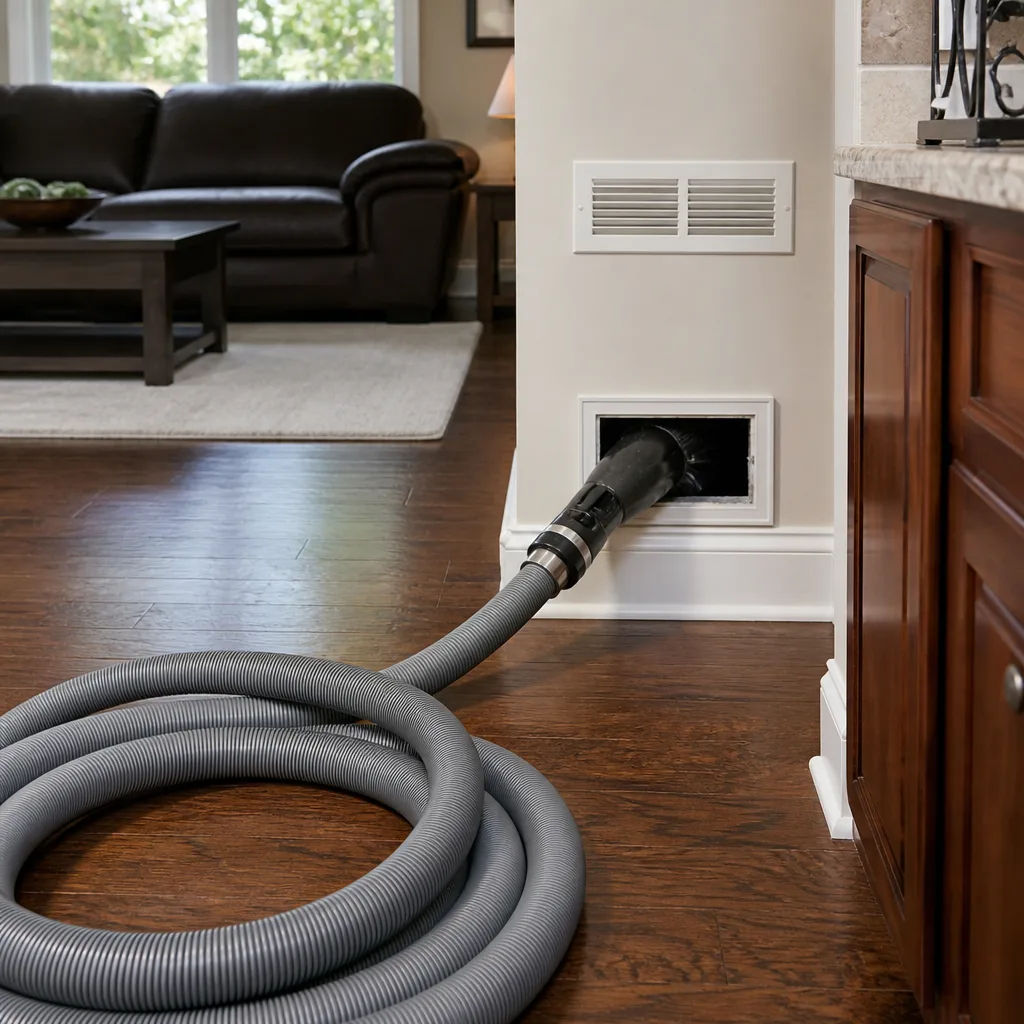 Whole-home duct cleaning
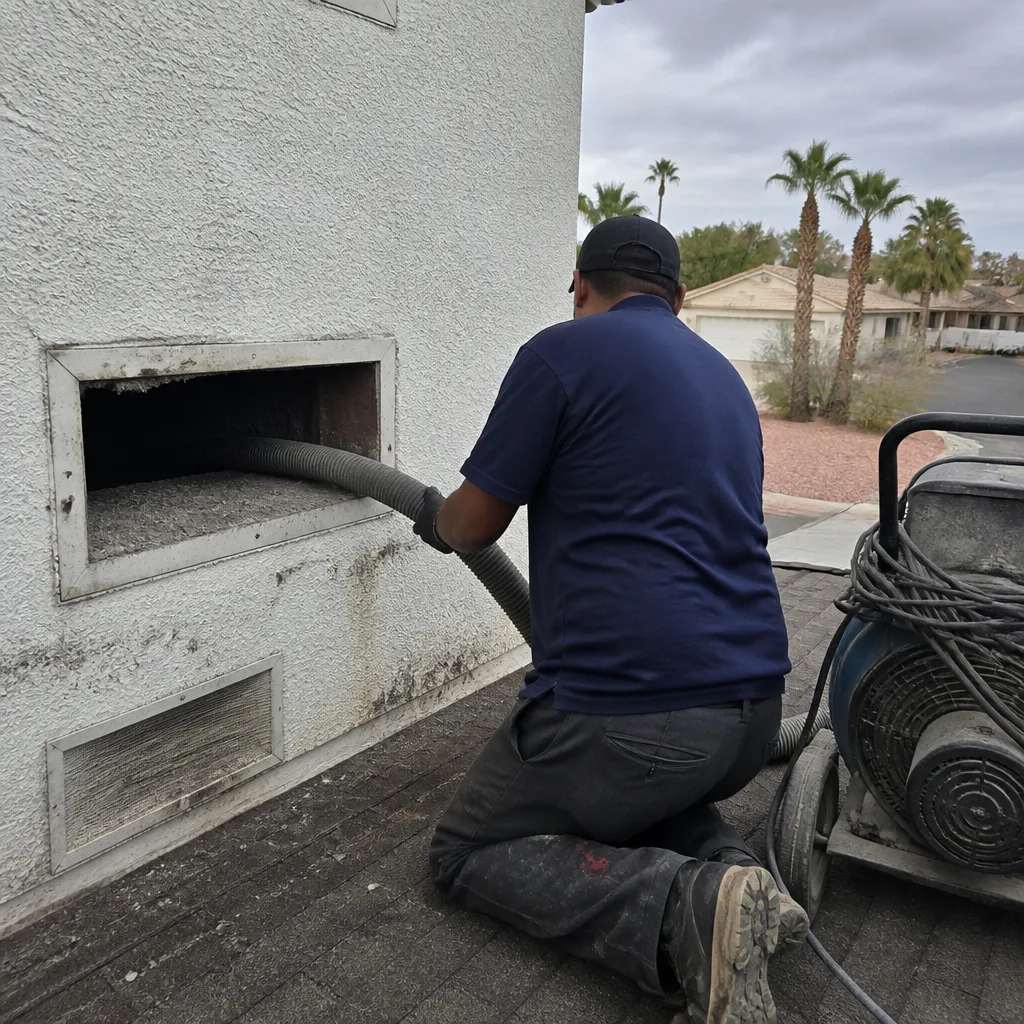
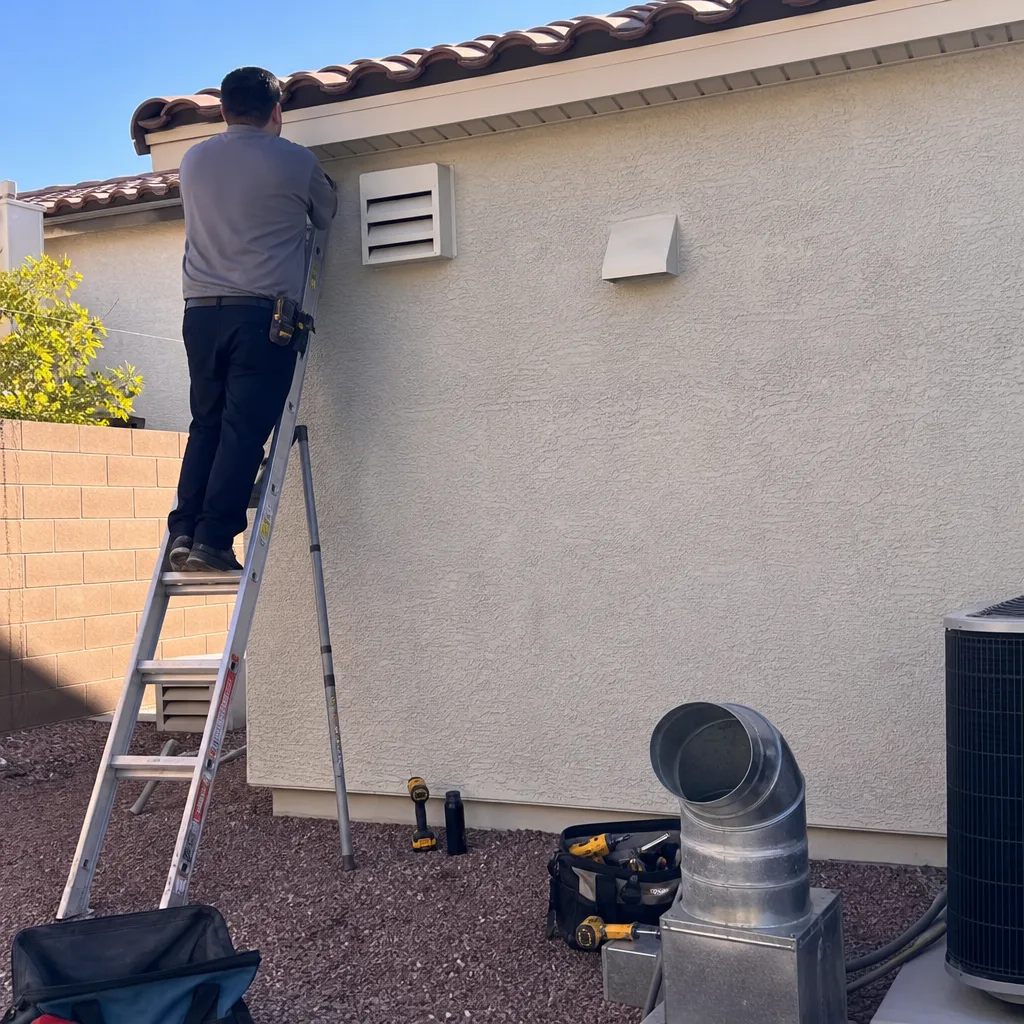
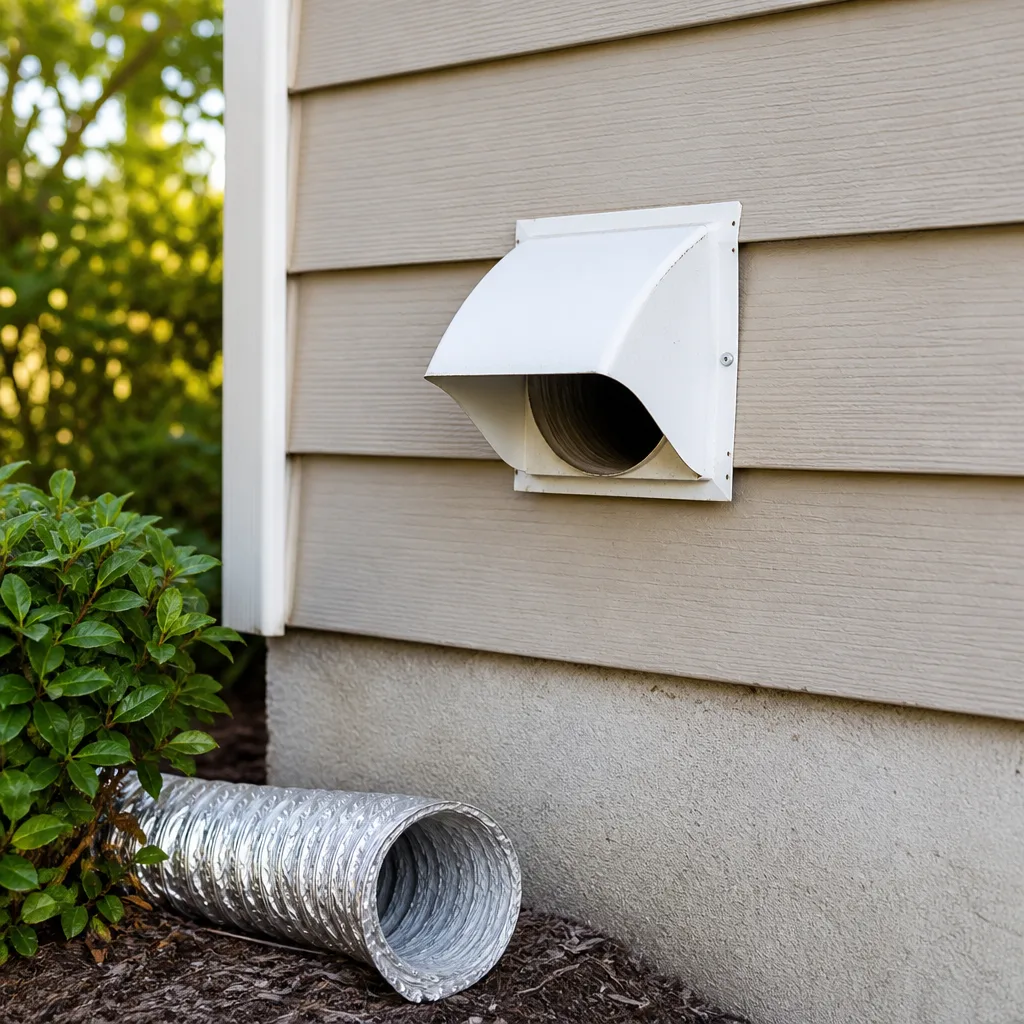 Dryer vent cleaning
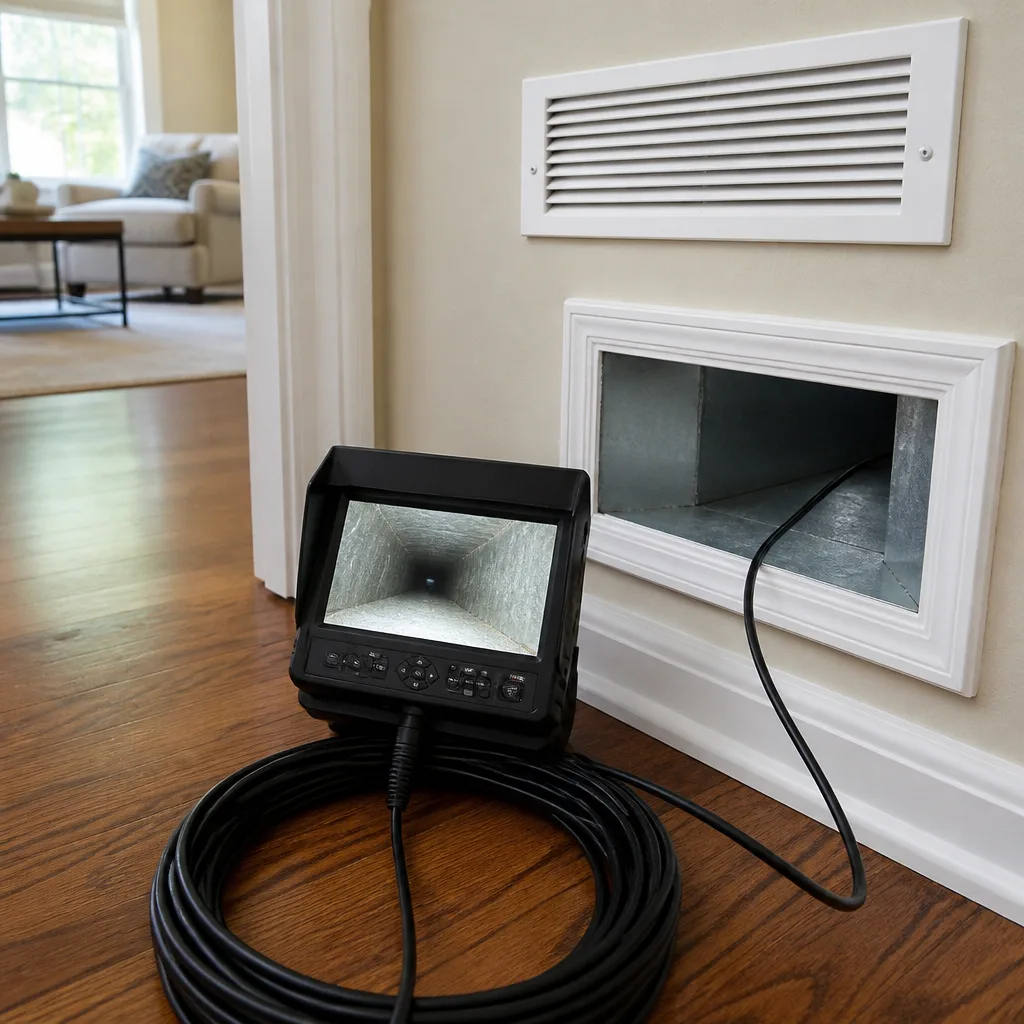 Camera inspection
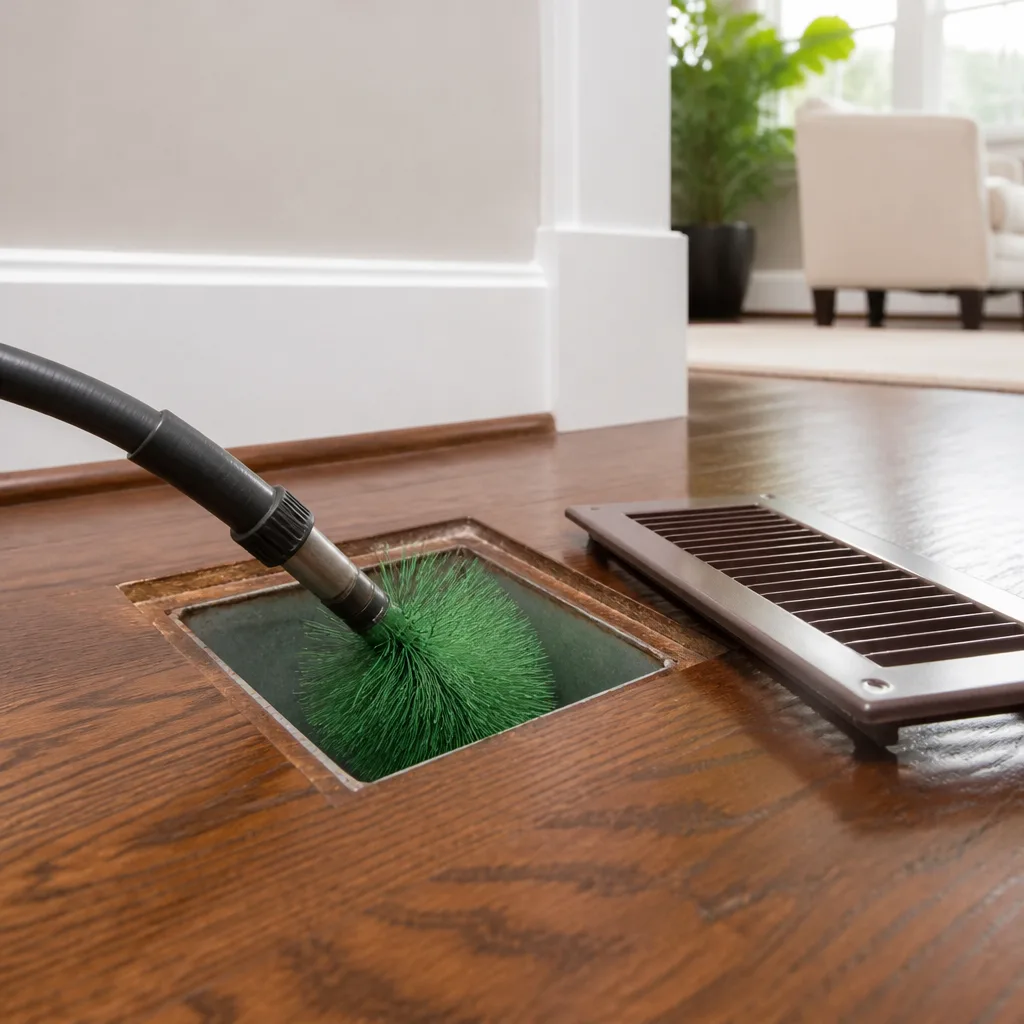 Sanitizing & deodorizing
Whole-system duct and dryer vent check with before-and-after photos - you see exactly what came out of your vents
That "$99 whole-house special" is a bait ad - the real number appears once they are in your hallway, or the "clean" is a shop-vac at the register. We photograph the inside of your ducts before and after instead.
The Complete Guide to Air Duct Cleaning in Las Vegas
The Mojave Desert drops an estimated 40 pounds of dust per 1,000 square feet into the average Las Vegas home every year, and most of it finds a direct path into your return-air vents. That dust isn’t the fluffy gray stuff you remember from houses back East. It’s caliche-heavy, mineral-laden, and it behaves differently once it settles inside ductwork. This guide explains what actually accumulates in a Valley home’s ducts, why Las Vegas systems clog faster than anywhere else in the country, what Air Duct Cleaning services cost, what a legitimate cleaning looks like on a job site, and what a written guarantee should cover before you pay a dime.
Styles & brands we work with
Quick Answer
Air duct cleaning in Las Vegas typically costs between $350 and $700 for a complete single-family home, depending on square footage, number of stories, and how long the system has gone without service. The work involves negative-air extraction paired with rotary brush agitation to remove caliche dust, construction debris, and biological growth from supply and return ducts. A legitimate cleaning takes four to eight hours, includes a written scope of work before any equipment enters your home, and should carry a written guarantee covering the results for at least a year.
Table of Contents
- Why Las Vegas Ducts Are Different From Anywhere Else
- What Actually Accumulates Inside a Las Vegas Duct System
- How Much Does Air Duct Cleaning Cost in Las Vegas?
- What a Legitimate Negative-Air Cleaning Looks Like vs. a Blow-and-Go
- What a Written Scope of Work Must Include
- How Often Should You Really Clean Your Ducts in Las Vegas?
- What a Real Guarantee Should Cover
- Common Mistakes to Avoid
- When to Call a Professional
- Frequently Asked Questions
- The Bottom Line
Why Las Vegas Ducts Are Different From Anywhere Else
Las Vegas HVAC systems log more runtime hours than nearly any other market in the continental United States. A typical system in a moderate climate like San Diego or Portland runs about 800 to 1,000 hours per year. A Las Vegas system routinely logs 2,000 hours or more annually, and in a summer like the ones we’ve been having lately, that number pushes higher. The consequence is mechanical: your blower motor is pulling air through the return ducts for twice as many hours as a comparable home in a milder city, which means dust accumulates at roughly double the rate.
Then there’s the dust itself. The Las Vegas Valley sits on caliche, a calcium carbonate layer that forms in arid soils. Wind picks up fine caliche particles, along with silica from surrounding desert, and pushes it against every exterior surface. Your home’s HVAC system pulls outdoor air through fresh-air intakes, bathroom vents, and small gaps around doors and windows. The dust that enters isn’t the soft, organic household dust that vacuums up easily. Caliche dust is dense and mineralized. Inside ductwork, it packs against the duct walls under air pressure and forms a crust that resists simple suction.
Construction debris is the third factor. Las Vegas has been one of the fastest-growing metros in America for decades. If your home was built in Summerlin, Henderson, Centennial Hills, or any Valley subdivision during the last 25 years, your ducts almost certainly contain drywall dust, paint overspray, and insulation fragments from the construction phase. Builders rarely clean ducts before turning over keys. That debris has been in your system since day one, and it gets coated in caliche dust over time, creating a layered deposit that’s harder to remove than either substance alone.
The practical takeaway: generic air duct cleaning advice written for homeowners in Ohio or Georgia doesn’t transfer to Las Vegas. The dust is heavier, the runtime hours are higher, and the buildup forms a different physical bond with the duct surface. A cleaning method that works fine on light household dust in a moderate climate will underperform here unless the equipment and process are designed for what actually accumulates in a Valley home.
What Actually Accumulates Inside a Las Vegas Duct System
We’ve opened thousands of ducts across the Las Vegas Valley, and the contents are consistent enough to describe with precision. Here’s what you’ll find in most systems that haven’t been cleaned in five or more years:
- Caliche dust crust: A dense, light-gray to tan layer that forms along the bottom third of horizontal duct runs. It packs tightly under continuous airflow and resists removal with vacuum suction alone.
- Construction debris: Drywall dust, wood shavings, paint chips, and occasionally a soda can or fast-food wrapper dropped during the build. Newer homes in Las Vegas neighborhoods built after 2015 are especially prone to this.
- Pet hair and dander: Las Vegas has one of the highest pet ownership rates in the West. Hair binds with dust and forms matted clumps at return grilles and register openings.
- Skin cells and textile fibers: The universal household deposits that make up the bulk of fine dust. These are lighter than caliche dust but stick to it like a second skin.
- Biological growth: Contrary to what some duct cleaners claim, mold in Las Vegas ducts is less common than in humid climates. The Mojave air is too dry for heavy fungal colonization in most systems. What we do see is bacterial film from condensation on the cooling coil, which then sheds into the downstream supply ducts.
- Rodent and pest debris: Scorpions, crickets, and the occasional mouse find their way into ducts. Droppings and shed exoskeletons accumulate and become part of what your family breathes.
In neighborhoods like Anthem, Green Valley, and Mountains Edge, we also see landscape rock dust. The crushed granite and decomposed granite used in xeriscaped yards produces a fine powder that tracks into homes on shoes and paws, then circulates through the return-air system. It’s heavier than household dust and behaves similarly to caliche: it packs, compacts, and requires mechanical agitation to remove.
The reason this matters is simple. A shop vac or a cheap “blow-and-go” crew isn’t removing a packed crust from the duct wall. It’s blowing a loose layer of lighter particles around, then leaving the dense deposit exactly where it was. That’s why Las Vegas homeowners sometimes pay for a cleaning and see almost no difference in a few weeks: the crust remained, and new dust re-adhered to it immediately. For a deeper look at why this happens, see our DIY vs Professional Air Duct Cleaning: The Las Vegas Homeowner’s Decision Guide.
How Much Does Air Duct Cleaning Cost in Las Vegas?
You’ll see ads for $99 whole-house duct cleaning and you’ll see quotes for $1,500. Both extremes should make you suspicious. Here’s what real pricing looks like from a legitimate operator in Las Vegas, based on the systems we clean every week:
| Home Configuration | Typical Range | What Affects the Price |
|---|---|---|
| Single-story, up to 1,500 sq ft | $350 – $450 | 10-14 vents, single return, one air handler |
| Single-story, 1,500 – 2,500 sq ft | $425 – $550 | 14-20 vents, one to two returns |
| Two-story, 2,000 – 3,500 sq ft | $500 – $700 | 18-25 vents, two returns, longer duct runs |
| Two-story with casita or in-law suite | $600 – $800 | Separate smaller system or extended duct run |
| Dryer vent cleaning (add-on) | $75 – $150 | Length of run, roof vs. wall termination |
These ranges reflect a complete system cleaning: both supply and return ducts, the air handler, the cooling coil, and the blower assembly. They do not include replacement filters, which run $15 to $60 depending on whether you use standard fiberglass, pleated media, or a higher-efficiency option from brands like Honeywell or Aprilaire.
The price differences within each range come from three things: total linear feet of ductwork, how many returns your system has, and how long it’s been since the last cleaning. A home that’s never been cleaned in 15 years takes longer and costs more than a home on a five-year cycle. That’s straightforward labor math, not a hidden upcharge.
We believe you should know these numbers before you ever pick up the phone. The written price for your specific home, based on your square footage and configuration, should be in your hands before any work begins. That’s how air duct cleaning in Las Vegas should work every single time.
What a Legitimate Negative-Air Cleaning Looks Like vs. a Blow-and-Go
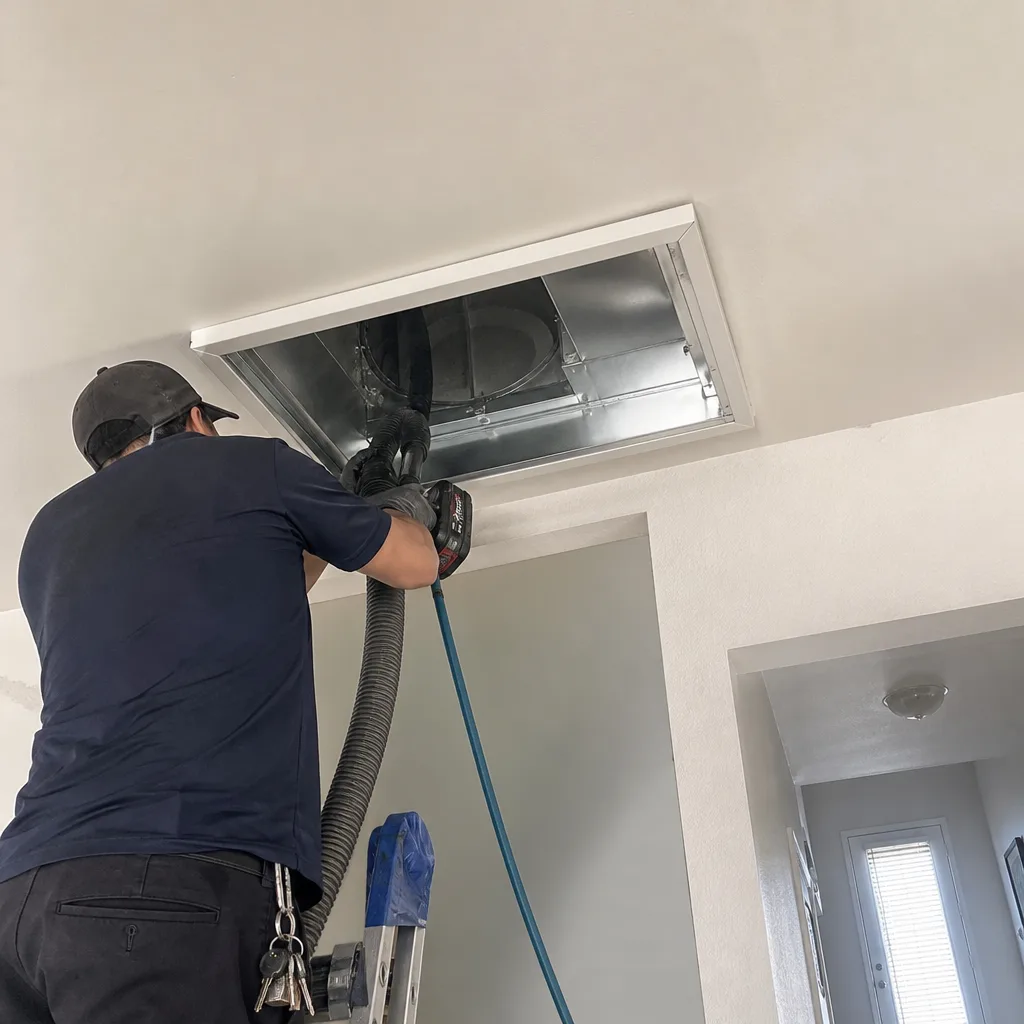
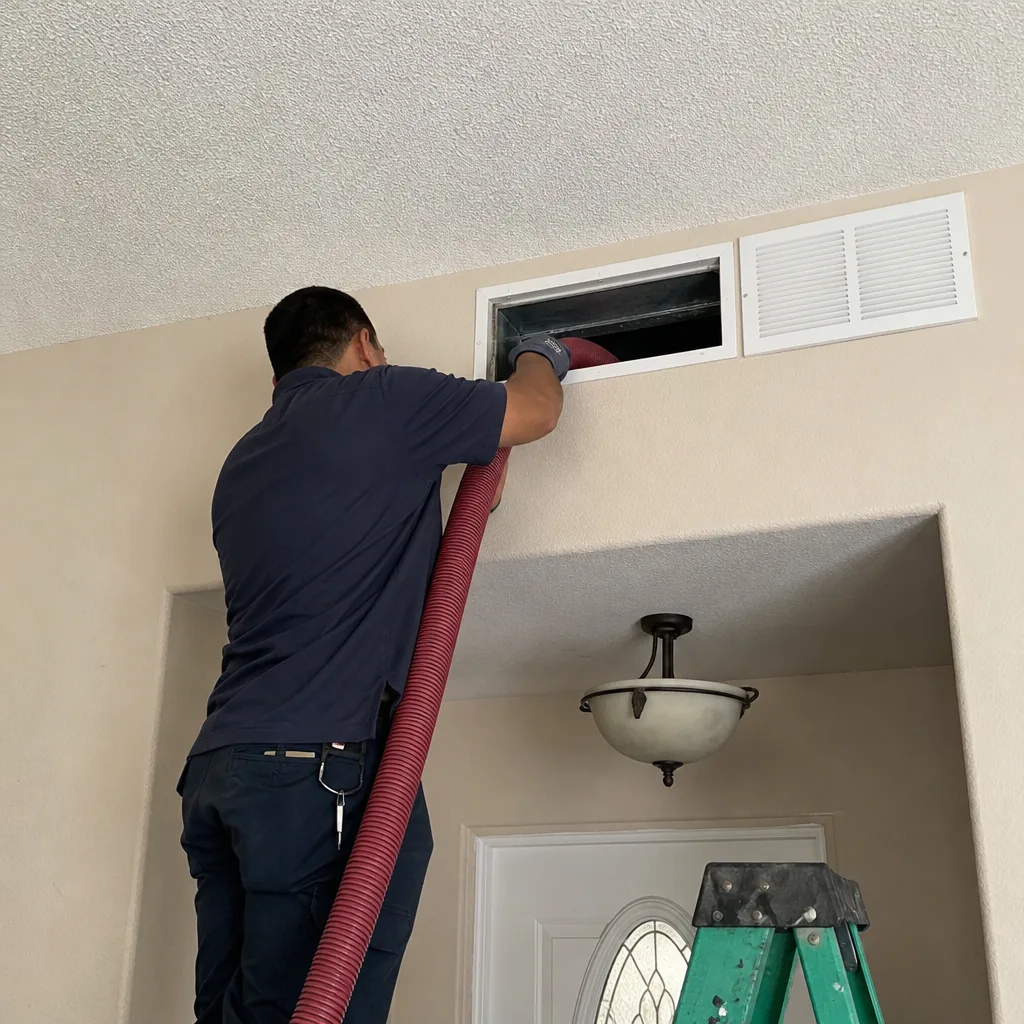
Negative-air extraction is the industry term for the proper method. Here’s what it means in plain English: a powerful vacuum unit creates continuous suction on the duct system while a rotating brush agitates the dust loose from the duct walls. The vacuum pulls the loosened debris out rather than letting it settle back into your home. It’s called “negative air” because the duct system is under negative pressure during the whole process, meaning air flows inward toward the vacuum, not outward into your living space.
A real setup uses equipment purpose-built for this work. The Rotobrush system, for example, is a rotary brush that runs down the length of each duct, dislodging packed debris at the duct wall while its integrated vacuum captures the material as it breaks loose. The Nikro units are negative-air machines that connect to the main trunk line and pull the entire system under vacuum. Both are commercial-grade tools designed for exactly this application. These are not box-store shop vacs with a long hose attached. They generate thousands of CFM of airflow and maintain it for hours.
A “blow-and-go” operation looks different. A technician shows up with a small portable unit, maybe a modified leaf blower or a rented vacuum, and runs a hose through your registers for 30 to 45 minutes. No negative pressure. No brush agitation at the duct wall. No cleaning of the air handler or coil. The technician blows loose dust around inside the ducts, sucks up whatever happens to reach the hose, and then hands you an invoice. Within weeks, the remaining crust re-attracts new dust, and you’re back where you started.
On a legitimate Las Vegas job site, you should expect the full process to take four to eight hours for a typical single-family home. The technician should seal off each register except the one being cleaned, run the brush and vacuum through every supply and return duct, open and clean the air handler cabinet, inspect and clean the cooling coil, and replace the filter. HEPA filtration on the negative-air machine keeps loosened particles from entering your living space during the work. If a crew tells you they’ll be done in an hour, they’re doing a blow-and-go, and you’re not getting what you paid for.
What a Written Scope of Work Must Include
Before any technician touches your system, you should have a written scope of work in your hands. Not a verbal explanation. Not a text message summary. A document you can hold or review that specifies exactly what’s included, what’s excluded, and what you’ll pay. Here’s the minimum a legitimate Las Vegas duct cleaning company should put in writing:
- Complete inventory of what will be cleaned: Number of supply ducts, number of return ducts, air handler cabinet, cooling coil, blower assembly, and filter housing. If the coil cleaning is excluded, it should say so in the document so you can make an informed decision about whether to proceed.
- The cleaning method and equipment to be used: “Negative-air extraction with rotary brush agitation” or equivalent language, naming the equipment type. You don’t need brand names, but you should know whether they’re bringing commercial negative-air machines or a portable vacuum.
- The total price in dollars: One flat number for the complete scope. Not a range, not a “starting at” figure, not a per-vent price that multiplies. One price for the whole system, agreed before work begins, with no legitimate reason for it to change when the technician arrives.
- Estimated duration: How long the crew will be in your home, within a defined window. You should have a written arrival window, and it should be honored or communicated if it slips.
- What happens after the cleaning: Filter replacement policy, whether before-and-after photos are provided, and how the technician will demonstrate the results. You should be able to see what came out of your ducts and verify the walls are clean.
- The guarantee, in writing: What’s covered, for how long, and how you invoke it. A verbal “we guarantee our work” means nothing. You need the terms on paper.
If a company won’t put the scope in writing before starting work, don’t let them touch your system. That’s not negotiable. We’ve operated under this standard since 2004, and the habit of documenting scope and price before work begins is the single biggest separation between honest operators and the rest of this industry.
How Often Should You Really Clean Your Ducts in Las Vegas?
The honest answer for Las Vegas is every 3 to 5 years, which is more frequent than the 5 to 7 year recommendation you’ll see in national guides written for milder climates. The desert dust load and extended HVAC runtime hours here justify the shorter interval.
Here’s the schedule we recommend for different Las Vegas households:
- Every 3 years: Homes with multiple pets, homes with allergy or asthma sufferers, homes backing up to open desert, homes with carpet throughout, homes where anyone smokes indoors.
- Every 4 years: Standard single-family homes with moderate pet dander, kids, and normal foot traffic. Most Las Vegas homes fall into this category.
- Every 5 years: Homes with tile or hardwood floors throughout, no pets, adults only, high-quality filtration, and windows rarely opened during wind season.
- Every 2 years or sooner: Homes that underwent recent renovation, homes with a rodent or pest intrusion, homes within a quarter mile of a construction site or freshly graded land.
One of the strongest signals that your ducts need attention is a fine dust film accumulating on furniture within days of cleaning. That dust is recirculating through your system. Another is visibly dark dust streaks around supply registers, which indicate particle deposition at the vent opening. If you’re seeing either, don’t wait for a calendar to tell you it’s time.
Dryer vents are a separate schedule. Dryer vent cleaning in Las Vegas should happen every 12 to 18 months, more often for large households doing daily laundry. A clogged dryer vent in a Desert Southwest attic run is a fire hazard, and the lint load in our dry climate accumulates fast.
What a Real Guarantee Should Cover
Most duct cleaning companies in Las Vegas offer no written guarantee. Some offer a vague “satisfaction guarantee” that means whatever they decide it means when you call back. You should demand better.
Here’s what a meaningful guarantee looks like in this industry:
- Specific coverage period: At minimum one year. Ours is a 365-Day Done Right Promise, and it’s written on every job we do. If the work falls short within that period, we return and make it right at no charge.
- Clear trigger conditions: The guarantee should state what constitutes a legitimate claim. For duct cleaning, that typically means visible dust buildup recurring within the coverage period, debris falling from registers, or airflow restriction traced to material the cleaning should have removed.
- A defined remedy: The guarantee should say exactly what happens when you make a claim: a return visit, a re-cleaning of the affected ducts, no charge, scheduled at your convenience within a defined window.
- No narrow exclusions: A legitimate guarantee won’t exclude the things that actually go wrong, like “coil re-soiling due to normal operation” or “dust accumulation after 30 days.” The guarantee should cover the ducts as a system, not just the parts that are easy to reach.
- Written on the invoice or scope: If the guarantee isn’t in writing, it doesn’t exist. Verbal promises don’t survive contact with a scheduling calendar.
When you call a company, ask them to read you the exact text of their written guarantee. If there’s hesitation, a long pause, or a pivot to “well, we stand behind our work,” you’ve learned what you need to know. A real operator can recite the guarantee from memory because they’ve honored it many times.
Common Mistakes to Avoid
- Choosing by price alone: The $99 whole-house offer in Las Vegas is a bait-and-switch in almost every case. The technician arrives, declares your system “heavily contaminated,” and the invoice becomes $800. The original price was never real. If the scope and price aren’t in writing before the truck arrives, the price isn’t real.
- Skipping the coil and air handler: Many Las Vegas companies clean only the ducts and ignore the cooling coil and blower assembly. In a desert climate, the coil is where dust, skin cells, and bacterial film concentrate. Cleaning ducts without cleaning the coil is like washing your hands and leaving the dirt under your fingernails.
- Not asking what equipment will be on the truck: If the answer is “a commercial vacuum,” you’re probably getting a blow-and-go. A legitimate operator can name their equipment: a Rotobrush rotary brush system, a Nikro negative-air machine, an Abatement Technologies HEPA filtration unit. The tools matter because the crusted caliche dust in Las Vegas ducts can’t be removed with suction alone.
- Falling for the mold scare: Some duct cleaners use a “mold test” as an upsell lever. They show you a dark spot on a register or a swab result and pressure you into a multi-thousand-dollar remediation. In Las Vegas’s arid climate, actual mold colonization in ducts is rare. Bacterial film on the coil is the real issue, and it’s addressed by proper coil cleaning, not expensive remediation. If someone claims mold without lab testing, get a second opinion.
- Not verifying the guarantee is written: A verbal guarantee is worth the breath used to speak it. Demand the terms in writing before work begins and look for a coverage period of at least one year.
- Cleaning the ducts but not the dryer vent: They’re separate systems with separate problems. Cleaning your air ducts doesn’t address a clogged dryer vent, which is a fire hazard on its own. If you’re bringing a company out anyway, ask about adding dryer vent service.
- Allowing per-vent pricing: Some Las Vegas companies quote a low number, then multiply by the number of vents, with each “extra” vent adding $30 to $75. Your home’s vent count is knowable in advance. A legitimate price is one flat number for the whole system, agreed before work starts.
When to Call a Professional
Duct cleaning is not a DIY job, and that’s not gatekeeping, it’s physics. The tools that actually remove packed caliche dust from duct walls are commercial negative-air machines and powered rotary brushes. They cost thousands of dollars and require training to operate without damaging duct joints or blowing debris through your home. If you’re seeing dust films on furniture within days of wiping, dark streaks around registers, reduced airflow from your vents, or unexplained allergy symptoms that improve when you’re away from home, call a professional. If you’ve never cleaned your ducts and your home is a Las Vegas build from the 1990s or 2000s, call even sooner. Kestrel Air Duct Las Vegas home offers free estimates for Las Vegas homeowners. Call (725) 210-0612 and you’ll talk to a person, not a queue.
Frequently Asked Questions
Most Las Vegas homes pay between $350 and $700 for a complete duct cleaning, depending on square footage, number of stories, and how long it’s been since the last service. Single-story homes under 1,500 square feet typically run $350 to $450, while two-story homes or homes with casitas run $500 to $800. The key is a written price for your specific home before work begins. Call (725) 210-0612 for an exact quote; estimates are free.
The ultra-cheap quotes, usually $99 or $149, are almost always bait-and-switch pricing designed to get a technician in your door, at which point the price rises dramatically. These operations also typically perform blow-and-go cleaning with portable vacuums that can’t remove packed desert dust from duct walls. A legitimate negative-air extraction cleaning with brush agitation takes hours, uses commercial equipment, and costs what it costs. If a price seems too low to support a half-day of professional work, it isn’t real.
Ask for before-and-after photos of your ducts taken from inside, not just shots of the equipment sitting in your driveway. A legitimate operator can place a camera inside the ducts before and after cleaning and show you the difference. You should also receive a written summary of the work: what was cleaned, what was removed, and confirmation that the coil and air handler were addressed. If a company can’t show you the inside of your ducts after the cleaning, ask why.
Every three to five years is the right interval for a Las Vegas home, with three years for pet homes, allergy sufferers, or houses backing up to open desert. The Valley’s dust load and extended HVAC runtime hours, roughly 2,000 hours annually, mean ducts here clog at roughly twice the rate of homes in moderate climates. If you see dust films on furniture within days of cleaning or dark streaks around vents, clean sooner.
For many Las Vegas allergy sufferers, yes, because the Valley’s airborne allergens, including desert pollen and caliche dust, concentrate inside duct systems and recirculate continuously. Removing the accumulated allergen load from ducts and the cooling coil reduces the total particulate burden in your air. However, ducts are part of a larger system. Pairing a cleaning with high-quality filtration, from brands like Honeywell or Aprilaire, gives you better maintained air between service visits.
Almost never. These offers exist to get a technician into your home, where the price gets revised upward, sometimes dramatically. A legitimate whole-house cleaning in Las Vegas requires four to eight hours of labor, commercial negative-air equipment, and a written guarantee. None of that fits inside a $99 price point. If you’re quoted $99, ask what the written scope of work includes and what equipment arrives on the truck. Then call (725) 210-0612 and compare.
The Bottom Line
Air duct cleaning in Las Vegas is not a luxury add-on. It’s a necessary maintenance task in a climate that pushes 40 pounds of dust per 1,000 square feet into the average home every year and runs HVAC systems hard enough to double the debris accumulation rate of milder cities. The dust here is caliche-heavy, mineralized, and packed into duct walls in a crust that simple suction cannot remove. A legitimate cleaning uses negative-air extraction with rotary brush agitation, includes the coil and air handler, comes with a written scope and a flat price before work begins, and carries a written guarantee of at least one year. Anything less, and you’re paying to move dust around, not remove it.
Written by Dale Whitmore, Owner at Kestrel Air Duct Las Vegas, serving Las Vegas since 2004.
See the difference
 Before
 After
After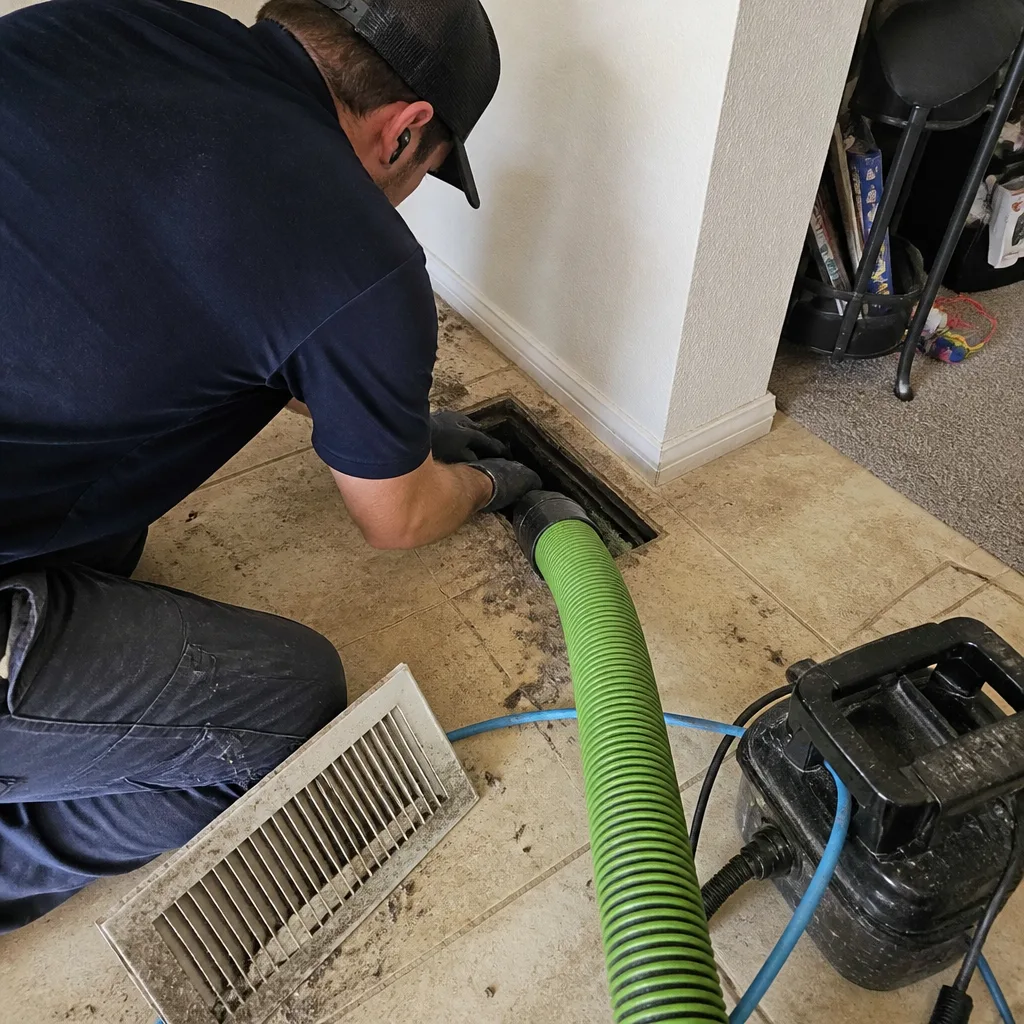 Before
 After
After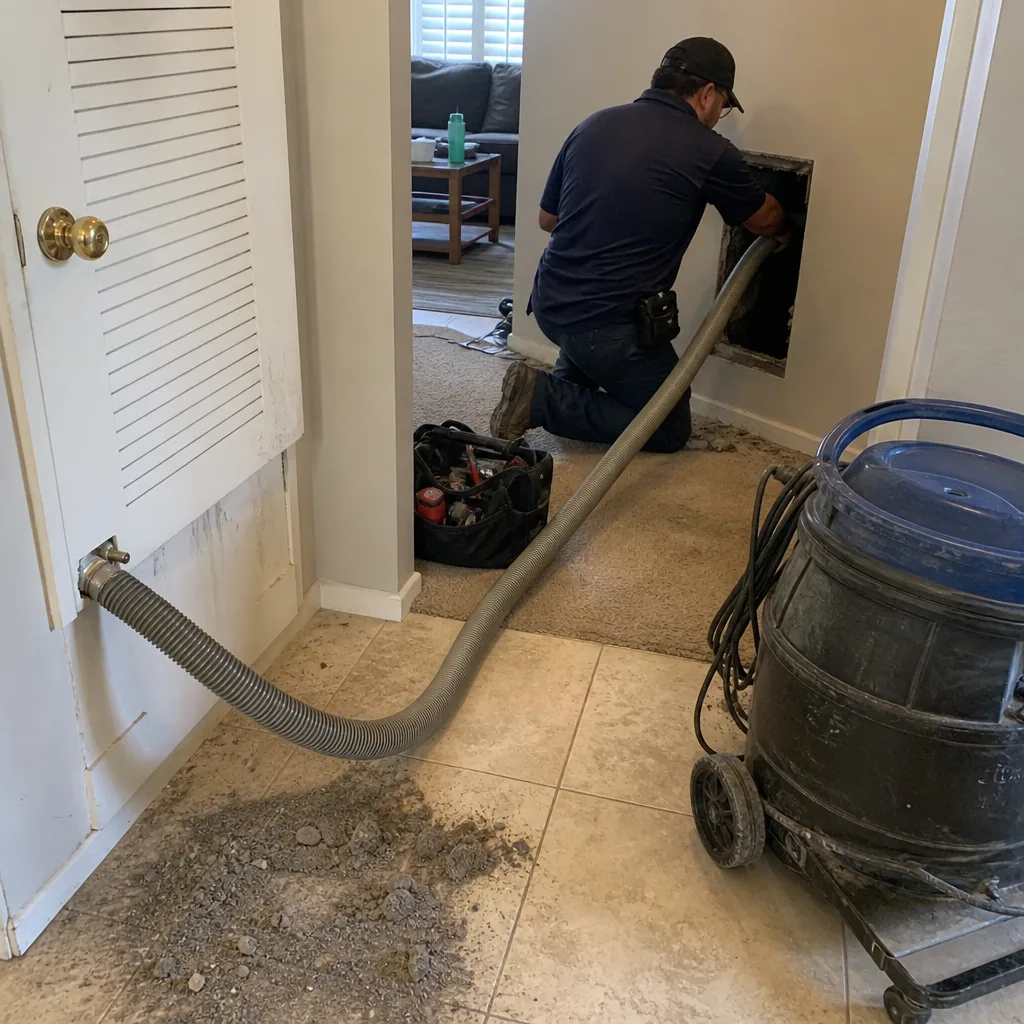 Before
 After
After